NFL London Games Betting: Props for Britain’s Growing Fanbase
 Available in US
Table of Contents
- The morning a London stadium roared and I finally understood the scale of it
- How big the UK fanbase really is
- The London Games and how they built a fanbase
- Demand that outstrips supply
- How the London context shapes prop betting
- Kick-off times and the practicalities for British viewers
- Enjoying the spectacle without losing the run of yourself
- What a sold-out Wembley tells the betting markets
The morning a London stadium roared and I finally understood the scale of it
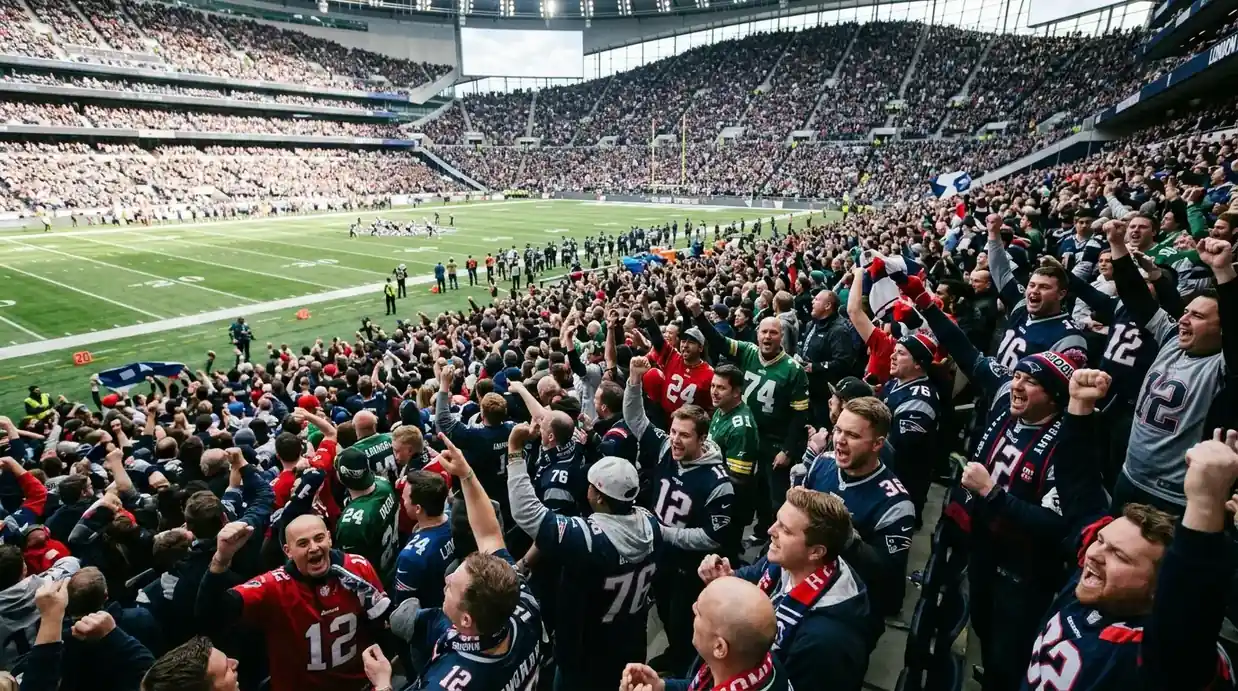
I have been to a fair few sporting occasions in this country, but the first time I walked into a packed stadium in north London for a regular-season NFL game, the sheer noise of it rearranged my sense of how big this thing has become. Eighty-odd thousand British voices, jerseys from all thirty-two teams, a genuine end-zone roar at nine in the morning local time. This was not a curiosity. This was a sport that had quietly grown a second home.
That growth is the story this article connects to player props, and it is a connection nobody in the search results has bothered to make. Britain is now home to more than 13 million NFL fans, around 4 million of them classed as avid, and the London Games have become the beating heart of that fanbase. What I want to do here is join two things that usually get discussed in separate rooms: the remarkable scale of British NFL fandom, anchored by the London fixtures, and the prop-betting markets that fandom feeds. Not the general shape of the UK betting market, which a separate piece maps in full, and not a breakdown of specific prop types — but the particular bridge between Britain’s love of the London Games and the individual-player markets that love increasingly drives.
The reason the bridge matters is simple. Markets follow audiences. When a sport assembles 13 million fans and fills a stadium in 45 minutes, the betting product deepens to meet the demand, and the British punter ends up with richer NFL prop markets than the fanbase’s age would suggest. The London Games are not just a spectacle; they are the engine that has dragged NFL betting in this country from the fringes toward the mainstream. Let me show you how.
Explore the wider NFL betting UK market beyond London game specials.
How big the UK fanbase really is
Quote someone the figure cold and they tend not to believe it. More than 13 million NFL fans in the United Kingdom, with roughly 4 million of them avid — the devoted core who follow a team, watch most weeks and could name a starting roster. That is not a rounding error on top of American football’s home audience. It is a fanbase comparable in scale to the support enjoyed by major domestic sports, built almost entirely within the last fifteen years.
The search data turns that headline into something you can feel. Around 1.2 million people in the UK look up “NFL” online every single month, a volume that represents roughly 13% of the searches in its comparable category. This is the texture of a mainstream interest, not a seasonal flicker — sustained, monthly, organic curiosity from over a million people, the kind of demand signal that betting operators read as clearly as anyone. When that many people are actively seeking out a sport month after month, the commercial logic of building deeper markets around it becomes irresistible.
Drill into who those fans support and the picture sharpens further. As of October 2025, the most-searched NFL team in the UK was the Kansas City Chiefs, commanding a 9.5% share of team searches, equivalent to roughly 50,000 queries a month on their own. That concentration matters for our subject, because British fans do not follow the NFL abstractly — they attach to teams and, increasingly, to individual players, and player attachment is the precise psychological soil in which prop betting grows. A fan who cares deeply about a particular quarterback or running back is a fan with a natural interest in whether that player throws for a certain yardage or finds the end zone. The fanbase is not just large; it is the right shape to drive the individual-player markets.
I dwell on these numbers because they are the foundation of everything else in this piece. The size and devotion of the British NFL audience is the proof of scale that justifies the betting infrastructure built around it. Thirteen million fans, a million-plus monthly searchers, team loyalties concentrated enough to predict where the betting interest clusters — this is a market that has earned serious commercial attention, and the London Games are where all of that fandom becomes visible, audible and undeniable in a single weekend.
The London Games and how they built a fanbase
You cannot tell the story of British NFL fandom without telling the story of the London Games, because to a large degree the games built the fandom rather than the other way around. What began as an experiment has become an institution, and the trajectory of the attendance numbers tells you exactly how seriously the league now takes its British home.
The scale is genuinely historic now. By the 2025 season the NFL had staged more than 40 regular-season matches in London since 2007, a milestone the league’s UK leadership marked directly. Looking ahead to that season’s slate, the general manager of NFL UK and Ireland framed it as a landmark moment, noting that the campaign would carry the capital past 40 regular-season games and welcoming three more franchises to the city. That is not the language of a tentative experiment. It is the language of a fixture firmly embedded in the league’s calendar, and the surrounding growth — including the more than 100,000 young people now playing flag football across the UK — shows the roots running far deeper than the headline fixtures.
The attendances themselves have become the clearest proof of demand. The 2025 London slate set a new capital attendance record when 86,651 spectators packed Wembley for the Jaguars and Patriots, while across the league’s seven games staged outside the United States that season, the most-attended international fixture drew 86,152 to Wembley for the Rams and Jaguars. Numbers like those are not soft. Filling an 86,000-seat stadium for an American football game played in England, on a Sunday morning local time, is a demonstration of appetite that no amount of marketing spin could manufacture. The fans turned up, in their tens of thousands, repeatedly.
What strikes me most, having watched this evolve, is how the relationship runs in both directions. The London Games created fans — people who attended, were converted, and went home to follow a team — and those fans then generated the demand that justified more London Games, and bigger ones. It is a flywheel, and it has been spinning faster every year since 2007. The 40-plus games milestone is not an endpoint; it is a waystation on a curve that still points upward, and every turn of that flywheel widens the audience that the betting markets serve.
Demand that outstrips supply
If the attendance records show that the London Games fill stadiums, the ticket data shows something even more telling: demand for these fixtures has, at times, dwarfed the supply by an order of magnitude. That gap between how many want in and how many can get in is the purest possible measure of how deep British enthusiasm runs.
The starkest illustration comes from the Tottenham fixtures in 2019, which were oversubscribed by a factor of twelve and sold out in 45 minutes — leaving an estimated 750,000 fans unable to buy a ticket. Sit with that figure for a moment. Three-quarters of a million people wanted to attend games that could seat a small fraction of them, and the entire allocation vanished in the time it takes to watch a single quarter of football. That is not the demand profile of a niche interest. It is the demand profile of a sport whose British appetite has comprehensively outgrown the venues available to satisfy it.
The clubs themselves understand exactly what they are walking into, and their enthusiasm for the London stage speaks to it. When the Cleveland Browns were named for the 2025 London Games, their ownership group spoke of being thrilled to make the trip and to play at the Tottenham Hotspur Stadium for the first time — the language of a franchise that grasps the commercial and emotional weight of the London market. Teams compete to be selected for these fixtures because the British audience represents genuine growth, new merchandise sales, new television viewers and new lifelong supporters. The 750,000 locked-out fans of 2019 were not a one-off anomaly; they were an early signal of a structural imbalance between British demand and available supply that persists to this day. Every sold-out fixture and every oversubscription is, for the betting industry, a flashing indicator of an audience hungry for more ways to engage with the sport they cannot always attend in person.
How the London context shapes prop betting
This is the bridge the rest of the article has been building toward, and it is the connection that makes this whole subject distinct. A fanbase of 13 million, anchored by London fixtures that sell out in minutes, does not just watch — it engages, and increasingly that engagement runs through individual-player markets. The London context shapes prop betting in ways that are specific and worth spelling out.
Start with the demand mechanism. With more than 13 million fans and around 4 million of them avid, and with that million-plus monthly search interest concentrating on specific teams and players, you have an audience whose engagement is fundamentally individual rather than abstract. People who attend a London game or watch it at home are not neutral observers of a contest; they are invested in particular players, and prop markets are precisely the products that monetise that individual investment. A fan who has travelled to Wembley to watch a favourite receiver is a fan with a natural pull toward a market on that receiver’s yardage or touchdown chances. The London Games concentrate exactly the kind of player-focused passion that prop betting is designed to capture, which is why these fixtures see such heightened prop interest.
That concentrated demand has a direct effect on the markets themselves. A London game is, for British books, a marquee event — a fixture their domestic audience genuinely cares about, played in a friendly time zone, with enormous attention on it. The natural response is to deepen the prop offering for these games, surfacing more player markets, more bet builder options and more granular individual lines than a typical mid-season American kick-off in the small hours would warrant. The British fan engaging with a London game therefore tends to meet a richer, more prominently promoted prop market than the sport’s relative youth in this country might lead you to expect. Demand has pulled the supply of markets upward.
There is a practical wrinkle worth naming, because it bears on how you actually bet these games. The London fixtures are played at British-friendly times — a Sunday afternoon or lunchtime kick-off rather than the late-night American slate — which means the markets are live and well-attended precisely when the British audience is awake and watching. That heightened, concentrated attention can sharpen the pricing on the marquee London markets compared with the thinly-traded overnight games, so the soft spots a careful bettor hunts for may sit differently here than on a routine domestic American fixture. Where you bet matters as much as what you bet, and the question of which British operators offer the deepest, most competitive NFL prop markets is its own subject — the comparison of UK bookmakers for NFL props goes through that properly. For our purposes, the headline is that the London Games are where British prop demand peaks, and peak demand reshapes both the breadth and the sharpness of the markets you will face.
Kick-off times and the practicalities for British viewers
One of the genuine pleasures of the London Games, and the thing I appreciate most as someone who has spent years following this sport at antisocial hours, is that for once the football comes to you at a civilised time. That practical reality has real consequences for how a British fan engages with the markets, and it deserves its own moment.
The London fixtures kick off in the British morning or early afternoon rather than the dead of night, which transforms the experience of following them. The wider NFL season demands genuine dedication from a British fan — the marquee American games routinely kick off late in the evening or after midnight UK time, and following them live is a test of stamina as much as fandom. The London Games suspend that tax entirely. You can watch a full game, fresh and alert, in daylight, surrounded by other fans, the way the sport is meant to be consumed. For the markets, this means a British audience that is awake, engaged and able to follow the run of play in real time rather than catching up bleary-eyed the next morning.
That alertness changes the practical relationship between the fan and the live markets. In-play prop betting — markets that update as the game unfolds — is only meaningfully accessible to someone actually watching, and the London time slot is the rare occasion when the entire British audience can be watching together. It is no coincidence that these are the games where British engagement with live and player markets peaks. The practical message I would give any British fan is to treat the London Games as the moment to slow down and watch properly, because the daylight kick-off is precisely what makes considered, real-time engagement possible in a way the overnight slate never allows. The sport rewards attention, and London is when attention is easiest to give.
Enjoying the spectacle without losing the run of yourself
For all my enthusiasm about the scale and the noise and the flywheel of British NFL growth, I would be doing you a disservice if I closed without a plain word about keeping the betting in its proper place. The London Games are a brilliant day out and a genuine sporting occasion. They are not a reason to bet beyond what you can comfortably lose, and the excitement of the crowd is exactly the atmosphere in which sensible limits tend to slip.
Bet only with operators licensed by the Gambling Commission, set a deposit limit before the game starts, and treat any stake as the cost of your enjoyment rather than an investment you expect to return. The British market is one of the most actively regulated in the world, and the regulator demonstrates that posture continually — the £5 stake limit introduced on online slots for all adults from April 2025, tightening to £2 for those aged 18 to 24 from that May, is a clear illustration of a jurisdiction willing to impose hard, specific constraints to protect players, and to protect younger adults in particular. That regulatory seriousness is part of the texture of betting in this country, and it exists to keep the activity safe.
The same licensed operators that take your London Games bet are required to offer you the tools to control it — deposit limits, time-outs, self-exclusion, reality checks. Using them is not a sign of a problem; it is the mark of someone enjoying the spectacle on their own terms. The London Games have given British fans something genuinely special: a home for a sport that used to feel impossibly distant, a daylight occasion, a stadium full of kindred spirits. Engage with the markets as part of that enjoyment if you choose to, with eyes open and limits set, and the connection between Britain’s remarkable NFL fandom and the prop markets it feeds stays exactly what it should be — a pleasure, not a pressure. That, more than any winning bet, is what will keep you coming back to the roar of a London morning year after year.
Visit best nfl player prop bets for expert NFL wagering resources.
What a sold-out Wembley tells the betting markets
Cast your mind back to that nine-in-the-morning roar I opened with. Everything in this article hangs off that sound, because a stadium of 86,000 British fans bellowing at an American football game is the single most eloquent piece of market data the NFL has ever produced in this country. It tells the betting industry, in a way no spreadsheet could, that the demand is real, deep and individual — fans attached to teams, to players, to outcomes they care about enough to travel for.
That is the bridge this whole piece set out to build. A fanbase of 13 million, anchored by London fixtures that sell out in 45 minutes and oversubscribe twelvefold, does not simply watch the sport — it engages with it player by player, and prop markets are the products that meet that engagement head on. The London Games are where British prop demand peaks, where books deepen their offerings to match, and where the daylight kick-off lets the entire UK audience follow the run of play in real time. The fandom and the markets are not two separate stories. They are one story, and London is its centre of gravity.
For the British bettor, the practical inheritance of all this is a richer, more prominent, more competitive set of NFL prop markets than the sport’s relative youth in this country would otherwise justify — markets that exist precisely because the fanbase grew large enough to demand them. Approach those markets the way you would approach the games themselves: with genuine enthusiasm, with limits set in advance, and with the understanding that the pleasure of caring deeply about a player on a Sunday morning is the whole point, whether or not a single bet ever lands. The roar built the markets. Enjoy both, on your own terms.
Which NFL team is most popular with UK fans?
As of October 2025, the most-searched NFL team in the UK was the Kansas City Chiefs, with a 9.5% share of team searches, equivalent to roughly 50,000 queries a month. British NFL support is concentrated enough that team loyalties are measurable, which is part of why player-focused markets resonate so strongly with the UK audience — fans attach to specific teams and players rather than following the sport abstractly.
Can I bet on NFL London Games with a UK bookmaker?
Yes. NFL London Games are covered by operators licensed by the Gambling Commission, and because these fixtures are marquee events for the British audience, books tend to offer particularly deep prop markets around them. Odds are presented in the fractions and decimals UK bettors expect rather than the American moneyline. As always, bet only with a licensed operator and set your limits before kick-off.
Do London kick-off times affect how props are priced?
They can. London Games kick off at British-friendly morning or afternoon times rather than the overnight American slate, which means the entire UK audience can watch and bet live and well-attended. That heightened, concentrated attention can sharpen the pricing on marquee London markets compared with thinly-traded overnight fixtures, so the value a careful bettor hunts for may sit differently here than on a routine domestic American game.
How many NFL games are played in London each season?
The number varies by season, but by 2025 the NFL had staged more than 40 regular-season matches in London since the International Series began in 2007. The 2025 slate welcomed several franchises to the capital and pushed the cumulative total past that 40-game milestone. London has become a firmly established part of the league’s calendar rather than an occasional experiment, with multiple regular-season fixtures staged there each year.
Created by the ”Best nfl Player Prop Bets” editorial team.