Live and In-Play NFL Props: Betting While the Game Moves
 Available in US
Betting against a clock that never stops
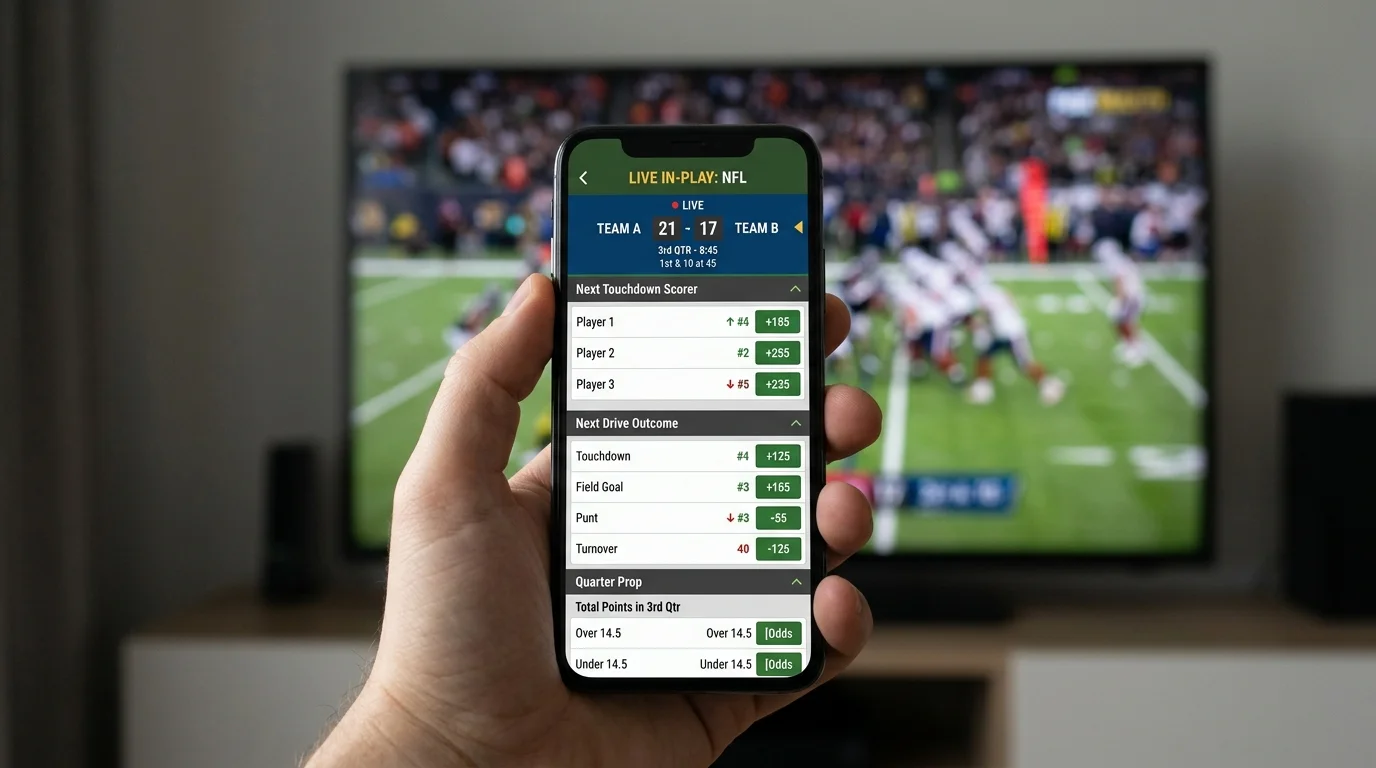
The first in-play prop I ever placed was rejected before I could finish tapping the button, and that rejection taught me more than any winning bet has. Live and in-play props are wagers offered during a game rather than before it, with prices that recalculate continuously as the action unfolds. The line you see is a snapshot of a moving picture, and the gap between that snapshot and reality is exactly where the difficulty and the opportunity both live.
What separates live props from the pre-match version is speed. A pre-match prop sits on the board for days, giving you all the time in the world to project, devig, and shop. A live prop exists for seconds, repricing on every play, every injury, every momentum swing. You are no longer betting against a static number; you are betting against a model that is updating faster than you can think, and that changes everything about how you approach the market.
The appeal is undeniable, and the industry knows it. Bettors keep pouring money into in-play and combination products, with same game parlays in particular having continued to skyrocket as one sportsbook product lead described the trend. Live betting rides the same wave: it is engaging, it is fast, and it is enormously profitable for the books. That last point is the one to keep in mind, because a product the house loves this much is rarely structured to favour the person on the other side of it.
Check NFL weather and passing props before placing in-play bets.
How live props are priced and offered
A live prop works by feeding the current game state into a pricing model that spits out new odds many times a minute. Every completed pass, every yard gained, every change of possession shifts the probabilities, and the book’s number moves with them. If a receiver you are eyeing for an over catches a long ball, his live over instantly shortens because he is closer to the target; if he gets shut out for a quarter, his over lengthens. The price is a living reflection of how the game has gone so far.
This constant recalculation is why live markets feel so different to trade. The pre-match number was the book’s estimate of a whole game; the live number is its estimate of the remaining game given everything that has already happened. That makes live props more reactive but also more tightly modelled in real time, because the book has fewer unknowns left to price. The further into a game you go, the less uncertainty remains, and the harder it becomes to find a number the model has genuinely got wrong.
The volume of money flowing into these markets keeps the books investing heavily in their live models, which raises the bar for anyone hoping to beat them. With in-play and parlay handle climbing year on year, the live pricing engines are well-resourced and quick. You are not up against a lazy number that has sat unattended; you are up against a system designed to update faster than human judgement, which is a humbling thing to bet into.
Speed, latency, and suspensions
Here is the trap that caught me on that very first live bet: the picture you are watching is behind the game. A live prop gets suspended the instant a play is in progress or a significant event occurs, because the book cannot price a market while the situation is actively changing. Try to bet during a snap, a scoring play, or an injury stoppage, and your bet is frozen or rejected until the book reopens the market at a new price. The suspension is the book protecting itself from being picked off mid-play.
Latency makes it worse for the bettor. Your television or stream is delayed by seconds compared with the live data the book uses, so by the time you see something happen and reach for a bet, the book has already repriced or suspended around it. You are perpetually a beat behind, betting on information the book processed before you even saw it. This is the structural reason casual live betting is so hard: the asymmetry of speed and information runs against you on every play.
The practical consequence is that you cannot react to what you just watched and expect to beat the price. By the time the play registers on your screen, the value created by it has already been absorbed. Live betting rewards anticipation, forming a view about what is likely to happen next before it does, rather than reaction, which is always too slow. If your live strategy is “I saw a big play, let me bet the over now,” the latency has already eaten your edge.
Explore best nfl player prop bets for real-time NFL wagering.
Where a live edge can still exist
Despite all that, live props are not unbeatable, but the edge sits in a narrow place: situations where the model overreacts to recent events. Books price on momentum, and momentum can be overweighted. A team that scores twice quickly might see its players’ live overs shorten more than the remaining game truly justifies, leaving the corresponding unders at value if you judge the run unsustainable. The edge is in having a steadier read on the rest of the game than a model chasing the last few plays.
That edge has to clear a higher cost, though. In-play vig tends to run wider than pre-match, because the book charges extra for the convenience and the risk of pricing in real time, and props already carry a steep margin of 6 to 10 per cent before any live premium. So a live prop you fancy must beat an even harder hurdle than its pre-match equivalent. I devig live prices just as I would pre-match, and I only act when my read on the remaining game diverges sharply from the model’s, because anything thinner gets swallowed by the inflated margin. Live betting on the most granular, play-by-play markets carries its own additional restrictions, which I cover in why single-play wagers are restricted. For ordinary live props, the rule is simple: anticipate, never react, devig the inflated price, and accept that the book has built this market to be very hard to beat.
Why does a live prop get suspended mid-play?
Because the book cannot price a market while the situation is actively changing. The instant a play is in progress, a score occurs, or an injury stops the game, the live prop is frozen so the book is not picked off at a stale number. The market reopens at a recalculated price once the event resolves. The suspension is the book protecting itself, and it is why you cannot bet during the very moments that matter most.
Is in-play vig higher than pre-match?
It tends to be. Books charge extra margin on live markets for the convenience and the risk of pricing in real time, layering a live premium on top of the steep prop margin that already runs to 6 to 10 per cent. That means a live prop must clear an even harder hurdle than its pre-match equivalent before it offers value, which is one more reason casual in-play betting is so difficult to turn a profit on.
Can latency cost me a live prop bet?
Yes, constantly. Your television or stream runs seconds behind the live data the book uses, so by the time you see a play and reach for a bet, the book has already repriced or suspended around it. You are always a beat behind, betting on information the book processed before you saw it. This is why reacting to what you just watched does not work; the value created by the play has already been absorbed.
Written by the editors at Best nfl Player Prop Bets.