NFL Prop Betting Tools and Models: Using Data Without Outsourcing Judgement
 Available in US
A calculator is not a crystal ball
The biggest mistake I see new bettors make with prop tools is treating them as oracles rather than instruments. NFL prop betting tools and models are software products that generate projections, edge metrics, and devig calculations to help bettors evaluate player props faster. They are genuinely useful, and I use them daily, but they are aids to judgement, not replacements for it. The bettor who outsources their thinking to a model entirely is no better off than the one who ignores models completely; both have abandoned the part of betting that actually matters.
The market for these tools has exploded alongside the betting industry itself. One prop-focused platform recently surpassed a million dollars in annual recurring revenue with a community of over 250,000 users, set against a US betting market exceeding 100 billion dollars in annual turnover. That scale tells you two things: the demand for prop tools is enormous, and the money behind building them is serious. There are now more projection products, edge dashboards, and calculators available to the ordinary bettor than ever before, which is both an opportunity and a temptation.
The temptation is to believe that better tools mean less thinking, and that is exactly backwards. The proliferation of sophisticated models has made independent judgement more valuable, not less, because when everyone has access to the same projections, the edge moves to the bettor who knows how to interpret, question, and combine them. This piece is about using tools as the powerful instruments they are while keeping the one thing no software can supply: your own informed judgement about whether a number makes sense.
The types of tools available
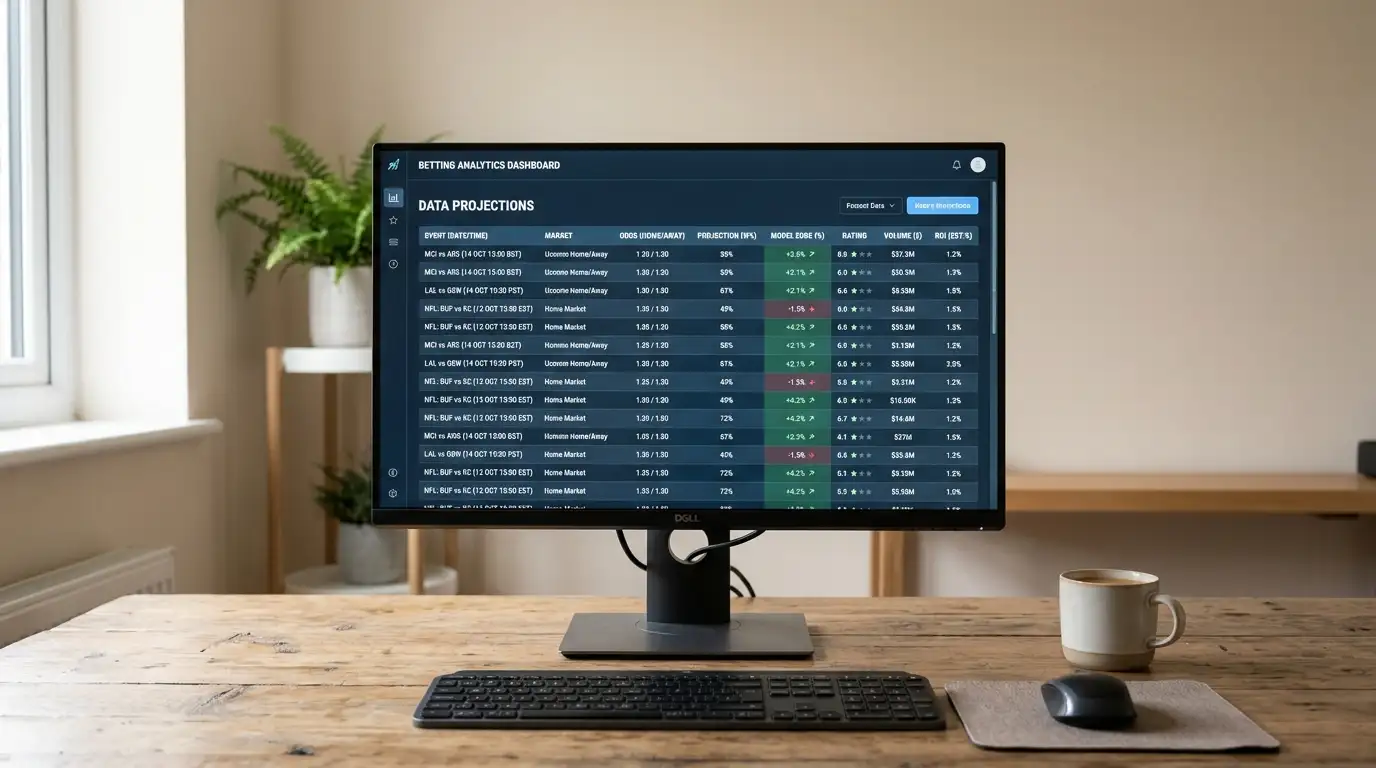
Prop tools fall into a few broad categories, and knowing what each does helps you use them well. Projection tools generate a predicted statistical output for a player, a model’s estimate that a receiver will gain a certain number of yards, for example, which you can compare against the book’s line. Edge tools take that a step further, comparing a projection to the available odds and expressing the gap as an edge metric, a quantified estimate of how much value a bet holds. Devig calculators do the focused job of stripping the bookmaker’s margin out of a price to reveal the fair, no-vig probability.
Each type serves a different stage of the betting process. A projection answers “what do I think will happen?”; an edge metric answers “is the price worth it given that projection?”; a devig calculator answers “what does the market really think the fair odds are?”. Used together, they form a workflow: project the outcome, find the fair line, and measure the edge between your view and the price. The better tools integrate these steps, but understanding them separately is what lets you judge whether the integrated output is trustworthy.
The philosophy that the best tool-builders themselves articulate is worth taking to heart. As the founder of one prop platform put it, the mission is to help sports bettors understand what they are doing and why. That framing is exactly right: a good tool should deepen your understanding, not replace it. A projection you cannot interrogate is a black box, and betting into a black box is just gambling with extra steps. The tools worth using are the ones that show their reasoning and leave the final judgement to you.
Reading edge metrics properly
The edge metric is the headline number on most prop tools, and it is also the most misunderstood. An edge metric expresses the estimated value of a bet, usually as a percentage, derived from comparing the tool’s projected probability of an outcome to the implied probability of the offered odds. A positive edge means the tool believes the bet has value; the larger the number, the larger the supposed value. It looks authoritative, and that authority is precisely what makes it dangerous if taken at face value.
The critical thing to understand is that an edge metric is only as good as the projection underneath it, and the projection is an estimate, not a fact. A tool showing a large edge is not telling you a bet is good; it is telling you that the difference between its model’s view and the market’s view is large. That difference can mean the model has found genuine value, or it can mean the model is wrong, and a suspiciously large edge often signals the latter. When a tool claims a huge edge on a player prop, my first instinct is not excitement but suspicion, because the market is usually not that wrong, and the model usually is.
This is why the sanity check matters so much. The standard reference point is the no-vig fair line, the price you get after stripping the bookmaker’s margin out, and any edge metric should be checked against it. If a tool’s projection implies a probability wildly different from the no-vig line, the sensible move is to ask why before betting, not to trust the model over the market reflexively. The method for calculating that fair line yourself is the foundation of evaluating any tool’s output, and I lay it out fully in vig and implied probability on props. A bettor who can devig a line by hand can judge whether a tool’s edge metric is plausible, and that judgement is the whole point.
Where models stop and judgement begins
Every model has limits, and knowing them is the difference between using a tool and being used by one. Models are built on historical data, and they struggle precisely where the data thins out, on secondary players, on unusual situations, on the new and the rare. This is the same reason exotic props on lesser players are mispriced by books: there is simply less reliable information to model. A projection tool inherits that weakness, so its confidence is often lowest exactly where it appears most certain, on the obscure markets a bettor might most want help with.
Models also cannot see what is not in their inputs. A projection does not know that a player is quietly nursing an injury the model has not been told about, or that a coordinator has signalled a change in approach, or that a forecast has shifted since the data was pulled. The human bettor, reading news, watching for role changes, and applying context, fills exactly these gaps. The ideal workflow is to let the model do the heavy computational lifting, generating projections and edge estimates at speed, while you supply the contextual judgement and the scepticism the model lacks.
So the honest answer to whether you need a paid model is no, you do not need one to bet well, though a good one can save time and sharpen your process. What you cannot do without is judgement, the willingness to question a projection, sanity-check an edge against the fair line, and override a model when context tells you it is missing something. Tools are instruments for thinking faster and more precisely, not substitutes for thinking at all. Use them to compute what is tedious to compute by hand, keep your own judgement firmly in charge of the final call, and the data becomes a genuine edge rather than a crutch that quietly leads you astray.
Do I need a paid model to beat prop markets?
No. A good model can save time and sharpen your process, but it is not a requirement for betting well. What you cannot do without is judgement: the willingness to question a projection, sanity-check an edge against the fair no-vig line, and override a model when context tells you it is missing something. Tools are instruments for computing the tedious parts faster, not substitutes for the thinking that actually generates an edge. Many sound bettors use free tools and their own analysis.
What does an edge metric actually mean?
An edge metric expresses the estimated value of a bet, usually as a percentage, by comparing a tool’s projected probability of an outcome to the implied probability of the offered odds. A positive edge means the tool believes the bet has value. But it is only as good as the projection underneath it, which is an estimate, not a fact. A suspiciously large edge often means the model is wrong rather than that genuine value exists, so it should always be checked, not trusted blindly.
How do I sanity-check a projection against the no-vig line?
The no-vig fair line is the price left after stripping the bookmaker’s margin out of both sides of a market, and it represents the market’s honest estimate of the true probability. To sanity-check a tool’s projection, convert it to an implied probability and compare it against that no-vig figure. If the two are wildly different, ask why before betting rather than trusting the model over the market reflexively. Being able to devig a line by hand is what lets you judge whether an edge metric is plausible.
Prepared by the Best nfl Player Prop Bets editorial staff.