NFL Kicker Props: Betting Field Goals and Kicking Points
 Available in US
The bet that rewards a stalling offence
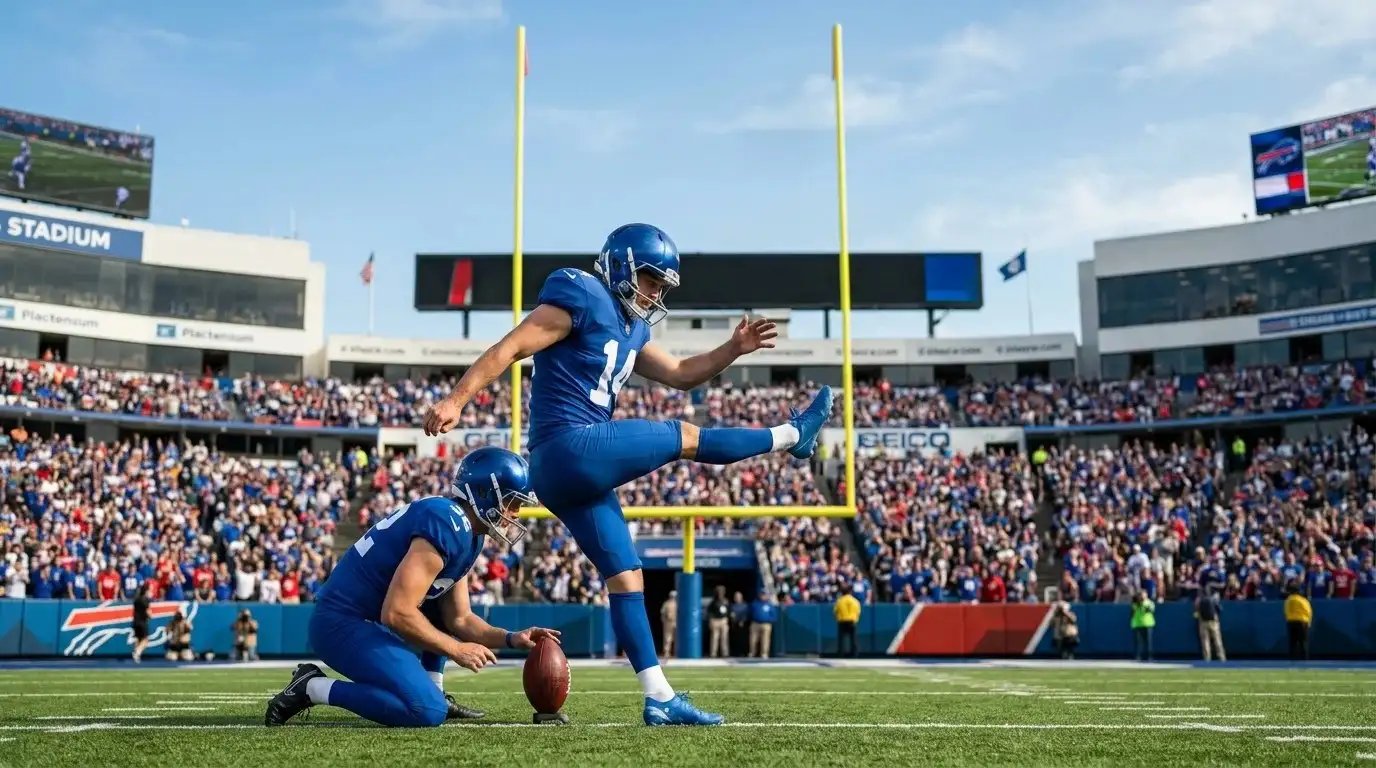
The most counterintuitive prop on the board belongs to the least glamorous player on the field, and that is exactly why I like it. NFL kicker props are wagers on a kicker’s output, most commonly the number of field goals he makes or his total kicking points across a game. What makes them fascinating is that they often work backwards from how casual bettors expect: a great offence can be bad news for a kicker, and a team that keeps stalling just short of the end zone can be a gift. Once that logic clicks, the market opens up.
The reason kicker props invert normal intuition is that a field goal is, in a sense, a failure to score a touchdown. A kicker only attempts a field goal when his offence has driven into range but could not finish the drive in the end zone. So the player whose props you are betting depends entirely on his team’s offence advancing far enough to try, yet not far enough to render him unnecessary. That narrow band, close but not all the way, is where kicking points are made, and reading it is the whole skill.
Kicker props are a niche corner of the market, less bet and less analysed than the headline yardage and touchdown lines, which is part of their appeal. The same heavy prop margins apply, the vig on props runs to 6 to 10 per cent and often higher, so you still need a real edge to profit. But the thinner attention means the lines can be softer, and a bettor who genuinely understands what drives a kicker’s output has a clearer path to value than on the heavily-traded star markets.
What the kicker market measures
The two main kicker props are made field goals and kicking points, and understanding the difference between them matters. Made field goals is a simple count: how many field goals the kicker successfully converts, settled over or under a posted line. Kicking points is broader, totalling all the points the kicker scores, which includes both field goals, worth three points each, and extra points after touchdowns, worth one each. The two markets respond to different game situations, which is why they need separate reads.
The crucial distinction is how each reacts to touchdowns. Made field goals counts only successful field goals, so a touchdown actively works against it, because a drive that ends in the end zone produces no field goal attempt. Kicking points, by contrast, captures the extra point that follows a touchdown, so it benefits from scoring of both kinds, field goals add three and the extra points after touchdowns add one apiece. A high-scoring team can therefore be poison for a made-field-goals over while being perfectly fine for a kicking-points over, because the touchdowns that kill one feed the other through extra points.
This split is the first thing I check when betting a kicker. If I expect a team to score plenty but mostly via touchdowns, I lean away from the made-field-goals over and consider kicking points instead, where the extra points accumulate. If I expect an offence that moves the ball but bogs down near the end zone, the made-field-goals over comes alive. Knowing which market matches which game scenario is half the battle, because betting the wrong one of the two is a common and avoidable error.
The stalled-drives logic
Here is the heart of kicker betting: the ideal scenario for a field-goal over is an offence that is good enough to advance but flawed enough to stall. Picture a team that consistently drives into the opponent’s territory, into field-goal range, but repeatedly fails to punch the ball into the end zone, settling for three points instead of seven. That team is a field-goal machine, and its kicker is racking up attempts precisely because the offence keeps coming up short of touchdowns. The kicker thrives on the offence’s red-zone failures.
The opposite scenario is the trap. A dominant offence that scores touchdowns on most of its drives gives its kicker little field-goal work, because every drive that ends in the end zone is a field goal that never happened. So a strong offence, which casual logic says should help a kicker, actually suppresses the made-field-goals total. The kicker on a touchdown-heavy team is busy with extra points but starved of field-goal attempts, which is exactly why a great offence can be bad for a field-goal over. This is the inversion that catches people out, and recognising it is the key edge in the market.
So when I read a kicker prop, I am really reading the offence’s red-zone tendencies. An offence that moves the ball but struggles to finish drives in the end zone points to field-goal value; an offence that finishes its drives points away from it. The team total matters too, a higher-scoring environment means more drives and more scoring chances overall, but the distribution between touchdowns and field goals is what actually decides the kicker’s fate. Read the offence’s habit of stalling, and the kicker prop stops being a coin flip and becomes a logical extension of how that team scores.
Weather, value, and the careful bet
Weather is the other major force on kicker props, and like passing, the condition that matters most is wind. A field goal is a long, precise kick through the air, which makes it acutely vulnerable to wind, far more than a short extra point. A strong wind reduces both the range a kicker can reliably attempt and his accuracy on the kicks he does take, which lowers the realistic made-field-goals total. A windy forecast is a genuine reason to lean toward the under on field-goal attempts, because some makeable kicks become misses or go unattempted.
This makes wind a usable angle on kicker props in the same way it is on passing props, and for the same physical reason: the ball travels through disrupted air. The detailed mechanics of how wind affects the kicking and passing game, and how slowly books adjust to forecasts, are worth reading in how weather moves NFL passing props, because the logic transfers directly. A bettor watching the forecast for passing edges should be watching it for kicker edges too, since a windy day suppresses both.
Pulling it together, the kicker value bet combines the stalled-drives read with the weather read, then runs it against a devigged price. I look for an offence likely to move the ball but stall short of the end zone, check the wind forecast, and bet the made-field-goals or kicking-points market that the scenario favours, but only when the fair price clears the steep prop margin. Kicker props reward the bettor willing to think backwards, to see a field goal as a stalled drive rather than a success, and to read the offence and the weather together. Do that, and the least glamorous player on the field becomes one of the more logical bets available.
Why can a strong offence be bad for a kicker over?
Because a field goal only happens when a drive stalls short of the end zone. A dominant offence that scores touchdowns on most of its drives gives its kicker few field-goal attempts, since every touchdown is a field goal that never happened. So a strong offence suppresses the made-field-goals total even though casual logic suggests it should help. The ideal scenario for a field-goal over is an offence good enough to advance but flawed enough to keep stalling.
Do extra points count toward kicking points?
Yes. Kicking points totals all the points a kicker scores, which includes field goals at three points each and extra points after touchdowns at one point each. This differs from the made-field-goals market, which counts only successful field goals. Because of that, a touchdown-heavy team can be poison for a made-field-goals over while being fine for a kicking-points over, since the touchdowns that prevent field goals still produce the extra points that feed kicking points.
How does wind hit a made-field-goals prop?
A field goal is a long, precise kick through the air, so it is acutely vulnerable to wind, far more than a short extra point. A strong wind reduces both the range a kicker can reliably attempt and his accuracy on the kicks he takes, lowering the realistic made-field-goals total. A windy forecast is a genuine reason to lean toward the under, because some makeable kicks become misses or go unattempted altogether in the conditions.
Created by the ”Best nfl Player Prop Bets” editorial team.