Fractional, Decimal and American Odds: Converting NFL Prop Prices
 Available in US
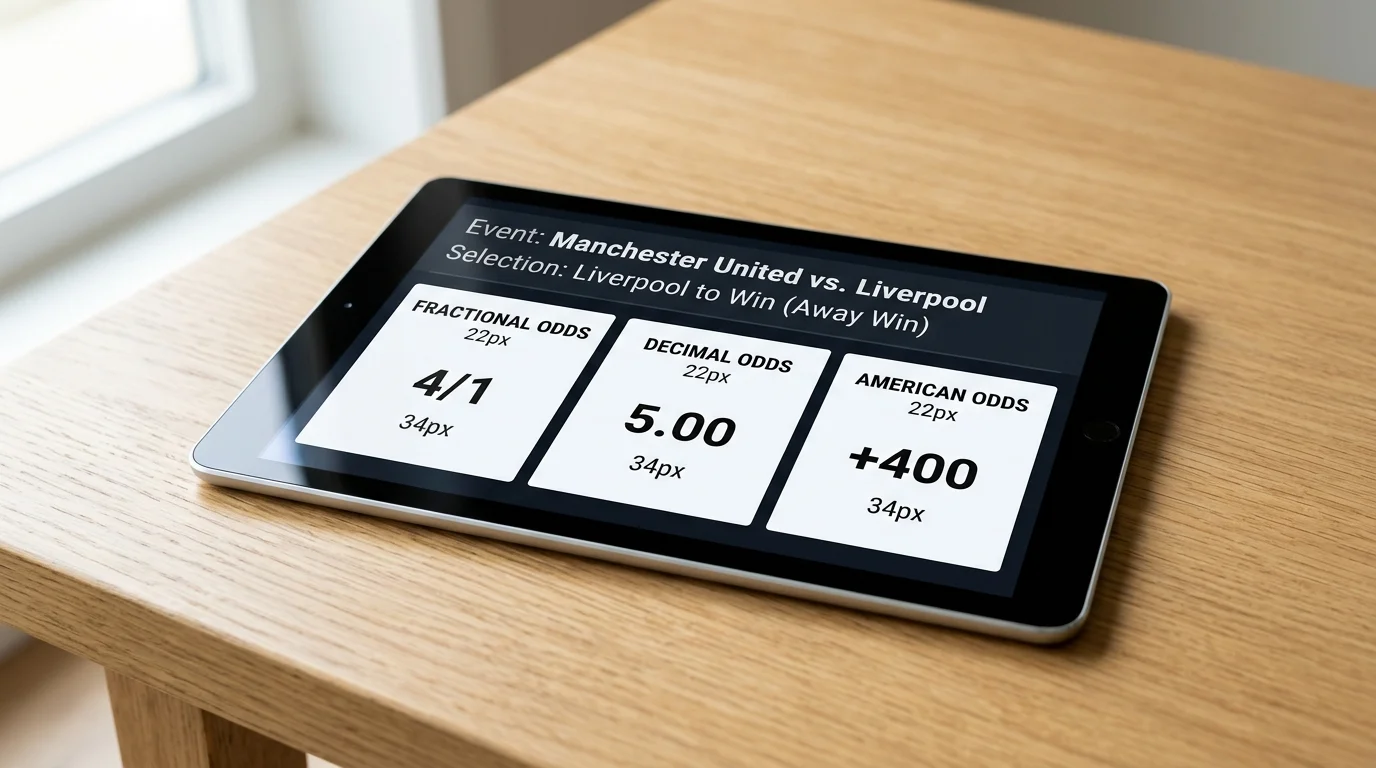
Three ways to write the same price
The single most useful thing I ever did as a bettor was stop thinking of fractional, decimal and American odds as three different things. They are three ways of writing the same price, like Celsius and Fahrenheit measuring the same temperature. Converting NFL prop prices between formats is simply translation, and once you can translate fluently you can shop a prop across any book or guide regardless of how it dresses up the number.
This matters because the prop world is multilingual. Your UK book defaults to fractions or decimals, US screens speak American, and a great deal of the sharpest analysis is published in whichever format the author prefers. If you can only read one, you are locked out of comparing the others, and comparison is where edges hide. A prop quoted 10/11 in one place, 1.91 in another, and -110 in a third is the identical bet; failing to see that costs you the ability to find the best of the three.
The reassuring part is that the maths is genuinely simple, just a handful of operations you can do on a phone calculator or in your head with practice. By the end of this you will be able to take any prop price in any format, convert it to the others, and verify the conversion is correct using a single sanity check. That last step is what separates careful bettors from people who fat-finger a conversion and bet the wrong number.
Dive deeper into reading American odds as a UK bettor.
The three formats and what each one shows
Each format answers a slightly different question, which is why people grow attached to the one they learned first. Fractional odds, the traditional British style, show profit relative to stake. A price of 5/2 means you win 5 for every 2 staked, so a 2 bet returns 5 profit plus your stake back. Evens, written 1/1, means you win exactly your stake. Fractions tell you your profit ratio, and nothing about your total return until you add the stake yourself.
Decimal odds, common across Europe and increasingly the UK default, show total return per unit staked, stake included. A price of 3.50 means a 1 stake returns 3.50 in total, of which 2.50 is profit. Decimals are the friendliest format for comparing prices and doing quick maths, which is why most serious bettors gravitate to them. The number you see is simply what one unit comes back as if the bet wins.
American odds, the US standard, use a baseline of 100 with a sign. A minus price shows what you stake to win 100; a plus price shows what you win on a 100 stake. So -110 means risk 110 to win 100, and +250 means a 100 stake wins 250. The format looks alien to British eyes, and if it still does, it is worth reading my dedicated walk-through of what -110 really means for a UK bettor before going further, because the conversions below assume you can read the sign at a glance.
The conversion steps, one format to the next
The cleanest way to convert is to route everything through decimal, because decimal is the universal hub. Once a price is in decimal, every other format is one short step away. Fractional to decimal: divide the fraction and add 1. So 5/2 is 2 divided into 5, which is 2.5, plus 1 equals 3.50 decimal. The 10/11 you often see on standard props is 10 divided by 11, about 0.91, plus 1 equals 1.91 decimal.
Decimal back to fractional reverses it: subtract 1 and express the result as a fraction. So 3.50 minus 1 is 2.5, which is 5/2. American to decimal splits by sign. For plus money, divide by 100 and add 1, so +250 becomes 3.50. For minus money, divide 100 by the number and add 1, so -110 becomes about 1.91. Going the other way, a decimal of 2.00 or higher is plus money, found by multiplying the decimal-minus-one by 100; below 2.00 is minus money, found by dividing -100 by the decimal-minus-one. Notice the recurring landmark: 10/11, 1.91 and -110 are the same standard prop price in three costumes. Memorise that one anchor and the rest follows by analogy.
Explore best nfl player prop bets for comprehensive NFL guides.
The sanity check that catches every error
Here is the habit that has saved me from more bad bets than any other: after converting, I always check the implied probability, because if it does not match across formats, I have made a mistake. Implied probability is the chance the price says the outcome has, and it is the same regardless of format. For decimal, it is 1 divided by the decimal odds. So 1.91 gives 1 divided by 1.91, about 52.4 per cent. That figure should be identical whether you started from 10/11, 1.91 or -110, because they are the same price.
That 52.4 per cent is also why the standard prop is not the fair coin flip it looks. A two-way prop quoted at -110, or 1.91, on both sides produces implied probabilities that sum to about 104.8 per cent rather than a clean 100, an overround of roughly 4.8 per cent that is the book’s built-in margin. The break-even win rate it implies is that same 52.38 per cent at -110, dropping to 51.22 per cent at the slightly kinder -105. If you convert a price and the implied probability does not line up with what you expected, stop and recheck, because a conversion error means you are about to bet a number you have misread. Run the probability check every time and the format never trips you up. Skip it, and one slipped decimal point can turn a value bet into a donation.
How do I convert 5/2 fractional into decimal?
Divide the fraction and add 1. For 5/2, divide 5 by 2 to get 2.5, then add 1 for the stake, which gives 3.50 in decimal odds. That means a 1 stake returns 3.50 in total, of which 2.50 is profit and 1 is your returned stake. The same method works for any fraction: divide the top by the bottom, then add 1 to include your stake in the figure.
Which format shows my total return vs profit?
Decimal odds show your total return, stake included, so a 3.50 price returns 3.50 per unit staked. Fractional odds show only your profit relative to stake, so 5/2 means 5 profit for every 2 staked, with your stake returned on top. American odds split by sign: plus money shows profit on a 100 stake, minus money shows the stake needed to win 100. Decimal is usually the easiest for seeing total return at a glance.
Do all formats give the same implied probability?
Yes, because they all describe the same price. Implied probability is the chance the price assigns to an outcome, and it does not change with format. The quickest check is 1 divided by the decimal odds, so 1.91 gives about 52.4 per cent. Whether you started from 10/11, 1.91 or -110, the implied probability must come out identical. If it does not, you have made a conversion error and should recheck before betting.
Written by the editors at Best nfl Player Prop Bets.